
Why is my dog reactive?
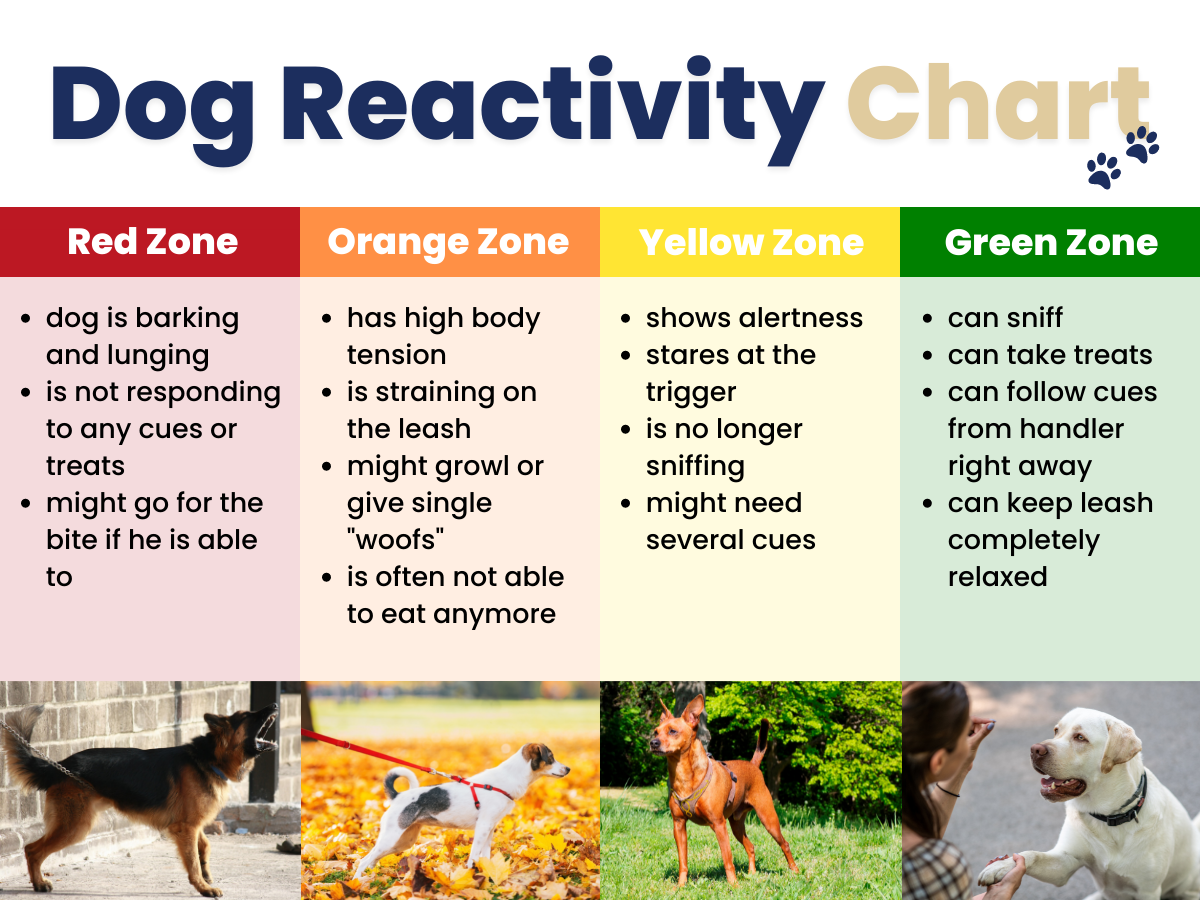
What actually is reactivity?
We need to define reactivity and break types of reactivity down before we decide if the dog is being ‘aggressive’ or ‘problematic’ or not. (Only in the worst case scenarios is a dog actually being ‘aggressive’, which is why we usually use the word ‘reactive’ instead, but it's the first word humans jump to when encountering a reactive dog.) Never forget- reactive literally means they are reacting to something they have no control over, (something is happening they are scared or stressed about, which can include being unwell or in pain) and we as their people need to find out what it is and do something about it.
We have numerous blogs on stress here and here, decompression here and here, and on ‘aggression’ here, but we can never discount a medical cause (80% of dogs might be reactive due to a health issue), a genetic issue in the breed that makes dogs more likely to quickly escalate to anger (see our blog on Spaniels for an example of this) or simply not having their (breed) needs met. And this can be made worse by not understanding our dogs’ body language, which is easily done even by the most well-meaning dog parent.
Unfortunately, canine reactivity is the most common problem people encounter in dogs. And a lot of that comes from not giving the dog a good foundation when they first come home (decompression) doing too much too soon with a dog, which overwhelms them and makes them lose trust in you having their backs if you don’t spot their low level stress body language. So they will go from 0-100 in seconds, as only when they’re marking, snapping, barking or lunging do they get human attention.
“...the mark now of a good dog owner is somebody who is actually fulfilling the dog’s basic needs. So letting the dog be a dog, training with the least invasive ways possible.”
Interview with Jean Donaldson, author of The Culture Clash, by Zazie Todd, PhD, 2016.
What sort of behaviours can be seen as reactive?
To help us understand a range of common canine behaviour issues Roshier and McBride’s (2013) list of 18 classic reactive behaviours will be used. Worryingly, all respondents identified one or more ‘behaviour concerns’ on a scale of minor to major.
Does your dog do any of these? If they do, which ones do you think are ok behaviours and which are a source of concern, and why?
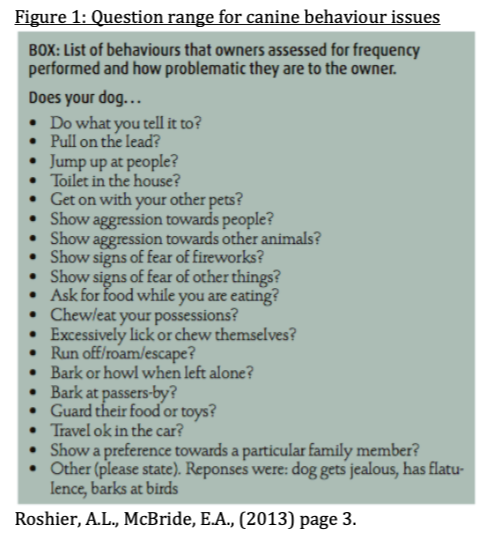
Note none of those issues were given any form of psychological aftercare by the vet, nor was any asked for by the clients, during this study once the list was put together.
These behaviours- pulling, inappropriate barking, actions described as ‘aggressive’, anxiety/ fear reactions, guarding (you, other humans, or other ‘high value’ items like toys, beds, food and treats, particularly ones it takes time to eat), and so on, are subdivided into four descriptive categories:
separation anxiety
generalised anxiety- this includes frustration from not being able to do normal breed based activities due to their human not knowing or wanting their dog to behave they way they do
‘aggressiveness’
and compulsive disorders.
Or simply: distress.
Stress exhibits problematic canine behaviour when their welfare needs (as defined by the Animal Welfare Act (2006)) are chronically not being met, due to inappropriate living environment, pain, or fear. Beginning with a Sympathetic Nervous System response, choosing between fight or flight (a term you might be familiar with), we add any breed mix genetic behaviours and past experience stressors known, to the five following environments that create canine problematic behaviour.
Biological- food control (too much or too little, or at illogical times when no positive actions have come from the dog (treats))
Physical/sensory- temperature or weather changes, moving to or visiting a new environment
Neurological- injury, interruption of oxygen supply to the blood and brain, recovering from
disease, or onset of dementias (Mosconi et al, 2008)
Psychological- negative reinforcement training/punishment, poor living conditions, new or
loud situations
Social- insecure or unpredictable environment, or the absence of an emotionally reliable
human carer
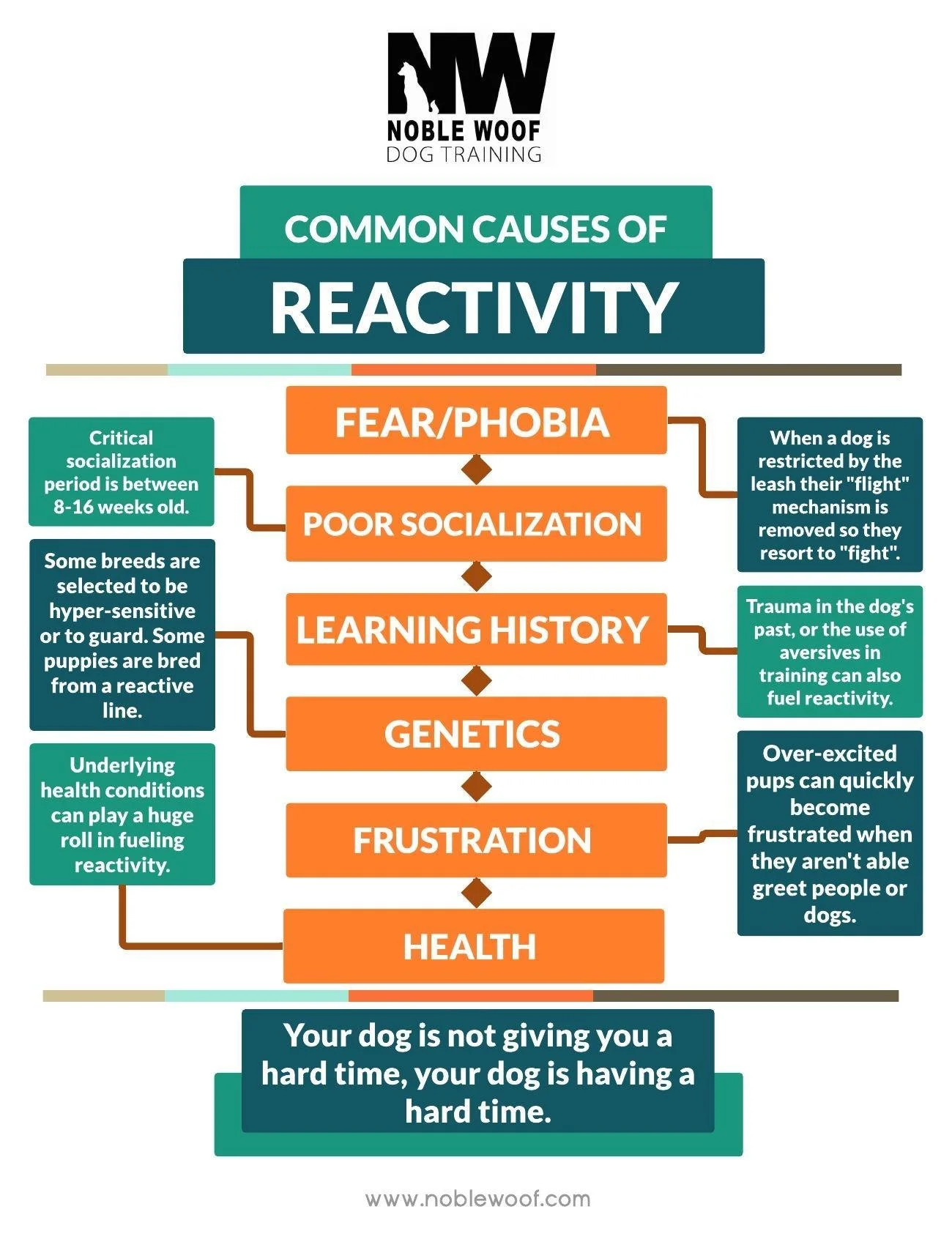
When the Internal Sympathetic Nervous System engages, not only ‘fight or flight’ can happen. There can be up to 6 ‘F’s’ behaviours-
‘favouring’ (healthy reassurance seeking),
’fidgeting’ (or ‘flirting’ or ‘fawning’), what is seen by humans as excitement or disobedience, when in fact it is low level stress behaviours
then ‘freezing’
or trying to escape- which is called ‘flight’
and when they are neither removed from nor allowed to leave a stressful, triggering environment, it leads to overwhelm enough to react in the final ‘fight’ stage, or actual aggression.
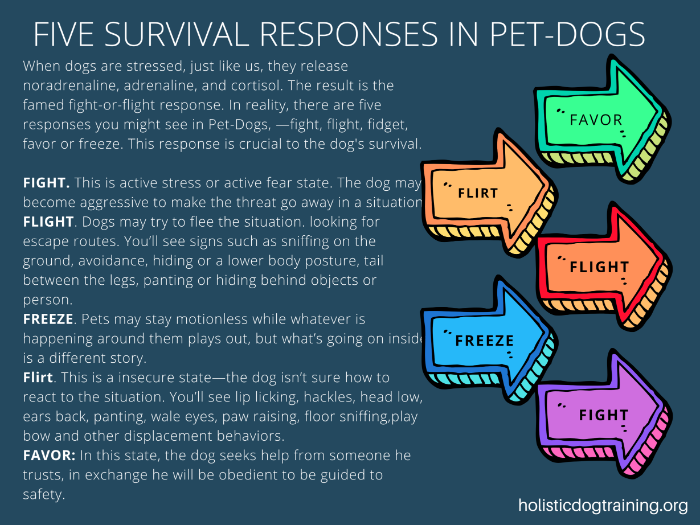
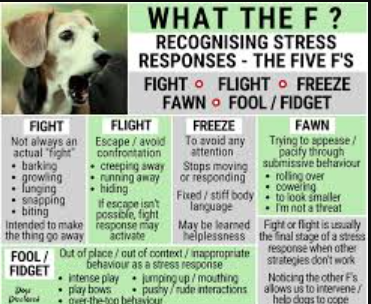
Good dog trainers don’t just look at the 2 ‘Fs’ (fight or flight). Many use a combination of the pictures above. They may exchange the ‘fidget’ stage with an appeasement or ‘fawning’ stage. And others add another, called ‘favouring’, or use ‘flirt’ (low level stress signals) instead of ‘fidget’.
What is Neutral Relaxation?
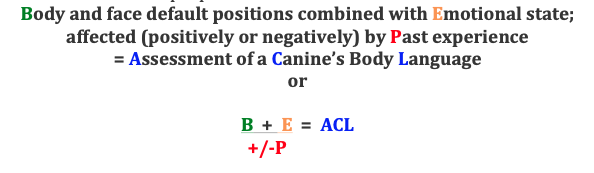
To get to the bottom of any reactive behaviour, the body language and behaviour ‘default’, or Neutral Relaxation, must be found (using the equation below, developed by our behaviourists)
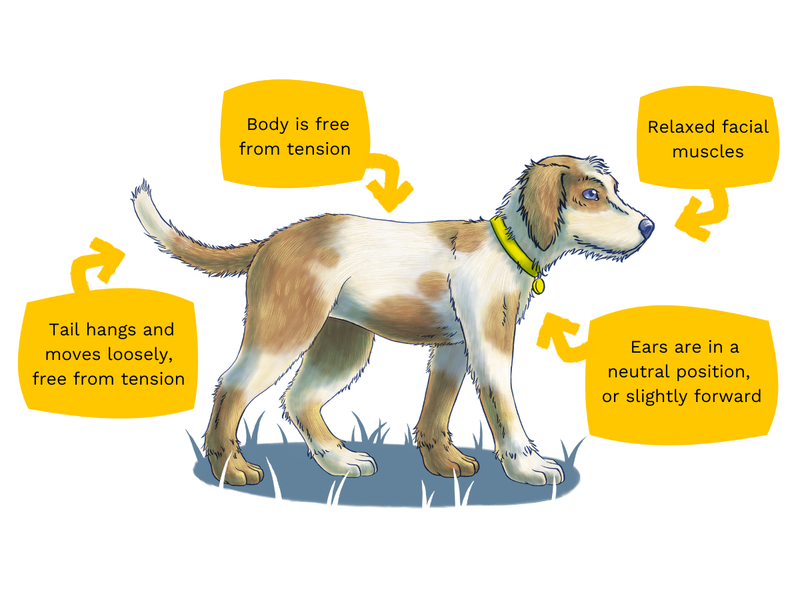
Neutral Relaxation is the perfect description of a dog literally being in balance, from the weight on their limbs to the face, ears, body and tail, showing friendly and welcoming body language by being soft and moving gently. Any other body language or emotional state of the dog is an escalation from neutral, or an exaggeration of default posture as expressed in the picture below.
This can be broken down into three main areas:
calming signals
body posture
and facial expressions (or microexpressions).
Analysing canine calming signals (also called distraction behaviour) is a task that should be done every day for your dog, from nose to tail, but especially ears, eyes, mouth and body position. More on this can be found in our stress blogs, but excessive licking (of the nose) and yawning frequently when not obviously tired are perhaps most common and most easily recognised by the human carer. However, there are many more expressions and actions dogs exhibit, all of which make them feel calmer due to a build up of stress. The response is a reaction to their environment. Stressed eyes can be staring hard at something, showing wide (dilated) pupils, look ‘tight’ around the sockets, or you can see more white than usual (whale or half moon eye.) Anxious mouths can drool, pant, lick excessively, lips and muzzles more inclined to wrinkle, or ‘smile’- appeasement body language (Prescott et al (2004) p.19). Scared bodies can crouch and tense, or freeze, even have an ‘arousal wee’ (Spain and Scarlett (2004) Abstract) or may stretch or shake more than usual. This list is of course not exhaustive and the canine must be seen in context, and not just one body part.
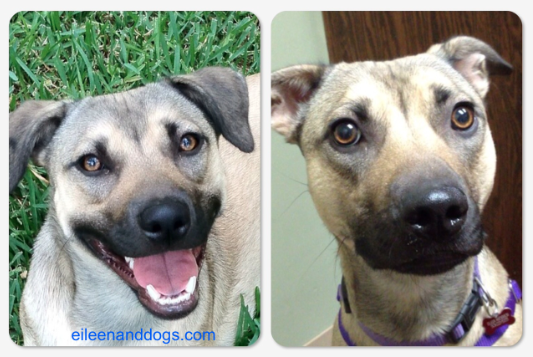
Can you tell which photo is Clara being stressed? Can you tell which photo is Clara being relaxed? Some dogs show it more obviously than others.
If your dog is doing any of this, or starts to do it more than usual, they are way too stressed, and as their human you need to step up and help them, especially as some of these can be pain responses as well, which needs a trip to the vet.
While well adjusted and well socialised canines will self regulate and when they feel arousal (or (over) excitement) rising (from play, going to new places or having new experiences), and remove themselves from the stressor, they do not come into the human home ‘naturally’ knowing how to do this. It is therefore the responsibility of the adopter to learn the merry-go-round context of play, activities, experiences and arousal in their dogs before misinterpreted signals become ingrained and problematic due to frustration from misunderstandings and miscommunication between the dog and the humans.
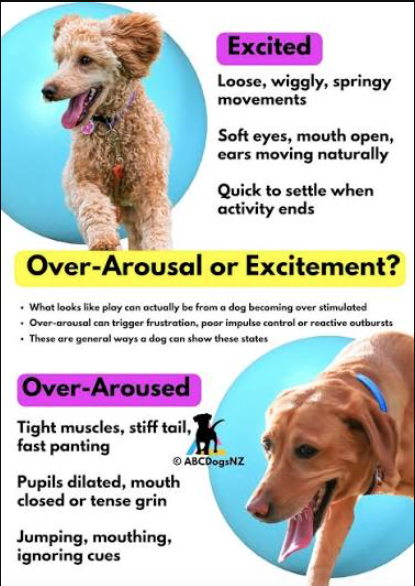
is your dog ‘happy excited’ and doing ‘normal’ dog things, or overexcited (a type of stress called arousal) and behaving ‘wrongly’ or’badly’?
Hackles by themselves are not always a sign of negative arousal, but they are a sign of arousal- and may be invisible on a stressed long haired dog, or displaying on a part of a dog that tends to suggest excitement rather than hostility. More on hackles can be found in this blog.

How can you tell this dog is happy?
But what exactly is a ‘problem’ in our dogs?
Problems only arise when the eustress (happy stress, or excitement) becomes distress and escalates to ‘arousal’- then we might see hard focused staring at the stressor, or leaning towards the stressor. (A ‘stressor’ is simply something or someone, or a situation that is stressing out the dog.) But we must remember that ‘arousal’ is merely the development of any feeling or emotional response to ones environment and perfectly normal for all living sentient creatures. The more negatively intense those feelings get in the dog the higher the distress levels, the higher the heart rate, and the body and face ‘tighten’ accordingly, even if the basic body positions on first glance appear similar (Rayment et al, 2013). Or a dog might start nipping, jumping up and grabbing at their human play partner when the play was not over stimulating to the human, but it clearly was to the dog. So ‘arousal’ is a scale of reaction and behaviour that can become all messed up and confused if not reinforced and guided by the human carers, but is not a negative behaviour in itself.
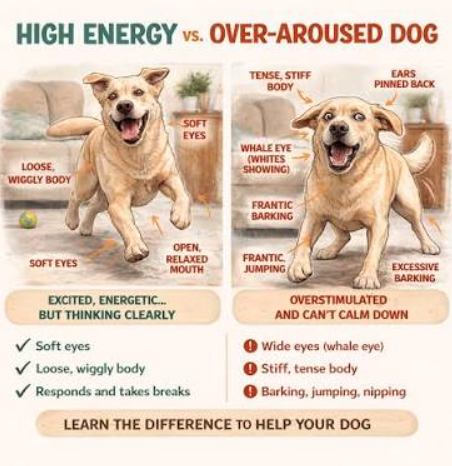
But it is up to us to notice when our dogs are getting wound up, stop the activity by removing the dog or the actitvity, and get them into their safe space like a bed only they can access, to give them a chance to calm down.
At the start of this blog, we talked about behaviour that humans see as a problem in dogs, and of course some of them are, but others are just dogs being dogs, or showing behaviour we bred into them (like digging, guarding, herding, barking, or being ok with other dogs and animals).
So we must separate the problematic (seriously affecting the quality of life of the dog) behaviour from inappropriate human expectations of canines that cause chronic distress. No, not all dogs are ‘friendly’ and that’s OK. But forcing a dog to ‘like everything and everyone’ can cause extreme distress even to the most social dog!
We have created the following three tables for you that we hope will help you to see where your dogs might be on the stress scales, and what may be stressing them out. Using what are called ‘reactive (Bennett (Ed) 2016) and disordered behaviour markers’ (Konok et al, 2015); (Beerda et al, 1999), they offer a framework to help redirect actual ‘bad’ behaviours. Realistically, we as a human carer may not adopt the dog before it developed problem behaviours so may have to work ‘backwards’ to even find the default of Neutral Relaxation, let alone de-stress the dog.
And sometimes we have to admit that we are the problem, not the dog, and adapt our attitude on what we think dogs ‘should be’.
Table 1a) below shows the reasoning behind and consequences of a canine’s attitude towards obedience (or ‘doing what they’re told/being a ‘good dog’’).
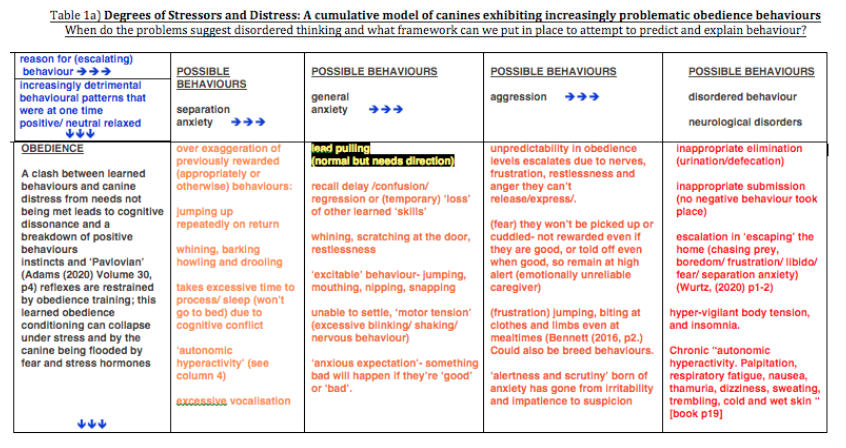
What is obedience?
Obedience is a desire in a dog to do positive location/temperament/skill/breed based ‘jobs’ and interactions in their (new) environment, and is selectively encouraged in dog breeding (Serpell and Hsu 2005) as a human-desirable quality. Human-canine interaction overrides a dog’s powerful hunger hormones (ghrelin) to prioritise the human’s body language and their interpretation of the human’s desires, even if it makes them stressed. Basically, dogs live to please humans, and we did it to them by breeding them that way. “Human body movements, to which dogs are attentive...may function as immediate” (Browne et al, 2014) rewards and cues for positive canine body language and behaviour over food (vital for survival). Therefore for something as basic as obedience to become erratic, unpredictable or negative shows something is really wrong in the bond between you and your dog.
Reacting what humans see as inappropriately to surroundings is the next stage of problematic behaviour, after obedience has become unpredictable or gone altogether. Dog become less reassured by their human carer because we’re not noticing they are stressed, and reactivity to (new) humans, other animals and other sensory input rises and adds to the dog’s anxiety (this is called escalation.) Thus all the behaviours in tables 1a) and 1b) can and will combine. As their welfare needs continue not to be met, the dog’s distress also rises.
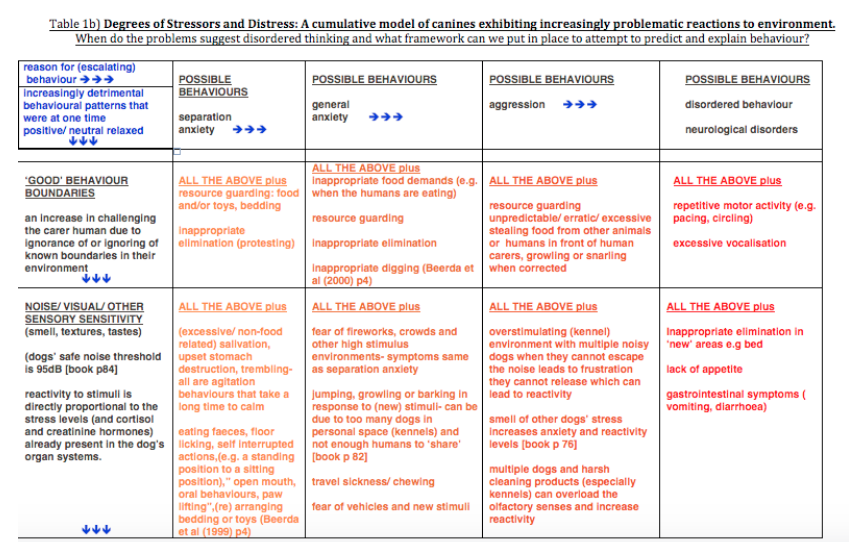
As your dog travels through the behaviours in Tables 1a) and 1b), without any help from their humans (it’s tempting as a human to ignore or even shout at a ‘misbehaving’ dog, and neither reaction works) it becomes harder to tell where they are in their stress levels, illustrated in table 1c) below. They start to expect no help in an unsafe or insecure environments and expect that any positive interactions between them are their humans are going to be temporary. For example, they may have been having a good day, then toilet in the house because they are over stimulated and haven’t been able to process (sleep off the day’s events in their safe space), then get shouted at for the mess but given no clue what they should be doing instead, such as taking them outside right away even if they’ve ‘been’, using your cue words for toilet (like ‘wee wees’ or ‘go to the loo’) to show them where they should ‘go’, because in their stress, they’ve temporarily ‘forgotten’ basic (obedience) training.
It’s vital you stop ‘problem behaviour’ before it becomes ‘normal’ to them, which is called ‘pathological’ (i.e. they can’t stop and don’t know what else to do.) ‘Discipline’ at this point will not be successful. Training they had down perfectly will no longer connect with how they are feeling now. With the dog likely unable to respond consistently (obedience), stress levels increase for the dog and their humans. The cycle of problematic behaviour continues on higher alert, as now the dog knows they cannot rely on the human carer to meet their needs. The home provided for the dog is now at a chronically substandard level of welfare, is actually making your dog ill from stress- and prolonged trauma can create neurological issues too (Landsberg et al 2013).
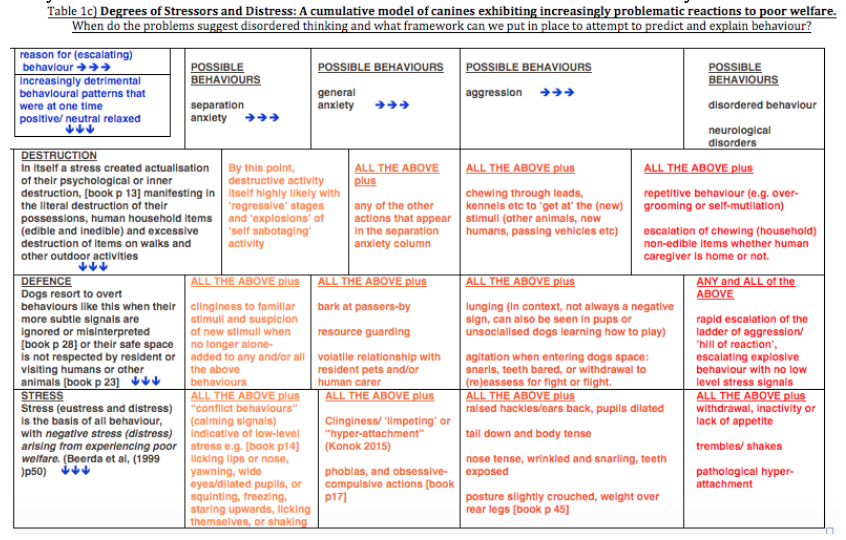
What can I do if my dog is showing behaviours on the tables?
So when communication between human carer and canine has
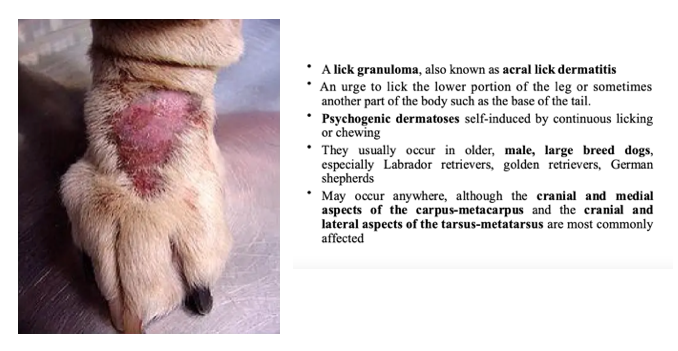
Inappropriate attachment (like fear bonding, limpeting (see our blog on this) or not allowing other humans to have relationships with their chosen humans, which we call monobonding and talk about in this blog) shown by your dog following you everywhere, howling when you go out, and chewing up the place, or at themselves, which can be so bad they make themselves bleed or end up with acral lick granuloma and requires an immediate vet visit.
has been subject to outdated, aversive (using punishment like ‘rubbing their nose in it’- please don’t do this!) and equipment like e-collars to make a dog ‘behave’) inappropriate or inconsistent training/past experience confusion arises in the dog, so they are less likely to interpret their humans’ body language to work out what behaviours the human(s) want. This results in the behaviours detailed in the tables. The body language stiffens, eating habits could change, and in house destruction and toileting, for example may well increase, as the dog closes down and as they are functioning at high alert, they escalate to ‘aggression’ much faster.

This makes the human carer distrust the canine as much as the dog has stopped trusting their human(s).
To break this cycle of spiralling canine-human confusion, frustration and anger (Gonzalez et al (2018)) a complete psychological reboot is needed, starting with
1. deconstruction of or ‘rebooting’ (starting all over again) the initial decompression as described in our ‘decompression blogs process, also called desensitisation
2. and rebuilding of the human-dog dynamic with a positive foundation is needed, also called counterconditioning

We should, therefore, go right back to basics, and learn every little thing your dog shows you in their body langauge (taking notes on this, and lots of photos and videos to look back at and zoom in on to help you see what’s going on) using our stress and decompression blogs to also help you. Once you have worked out all or at least most of your dog’s ‘signals’ you will start to see when to:
remove the stressor source/avoid the psychological trigger to give them breathing space to process (they must process in a safe space- a bed in a quiet area that no animals and humans come near) everything they experience every day, no matter how long you’ve had the dog. A stressor or trigger can be anything from an over friendly dog in the park to going to a cafe or the vets to playing too much or too roughly, or constantly fussing at them and picking them up and getting them wound up.

If a dog is in their ‘safe space’ (bed, teepee, on or under a blanket etc) they are asking for space- so let sleeping/chilling dogs lie!
use desensitisation (distancing from fear object till reactions are manageable, then slow reintroduction), and once they react well to such things from a ‘safe’ distance, counterconditioning (combining disliked experience with pleasure- like a low impact activity such as gentle fuss just for a minute then stop and retreat or let them move away, favourite toy (we have two toys blogs here and here as sometimes humans do not get what toys mean to dogs, here and here) or high value treat reward- only when they obviously show calm signals). it’s one reason why many compassionate vets will have treats on stand by to help the dog see it can be good at the vet as they’ll get something tasty. Some dogs however might be too stressed to eat, not be food led, or feel like they are being forced into an uncomfortable situation by being enticed by food, so never make them come forward into a ‘scary’ space or place to get food, always put on the floor then move away, roll or throw the treats behind them so they can retreat to a safe distance to retrieve.
try relaxation techniques and treatments like massage, music (Beerda et al (1997) or other sound frequency based audio/video, or dog safe herbal extracts in food and beds, or sprays and chews that calm dogs (Berns, Brooks and Spivak 2014) with dog appeasing pheromones (DAP) to reduce stress/fear aggression, through breathing it in. Please note that a lot of essential oils are very bad for dogs, so get professional advice from a qualified canine herbalist or physiotherapist before you try such things. And these methods will take a minimum of 3 days to take any effect as on average any dog needs 72 hours to process any and all their daily experiences, as we have already said in the stress blog.
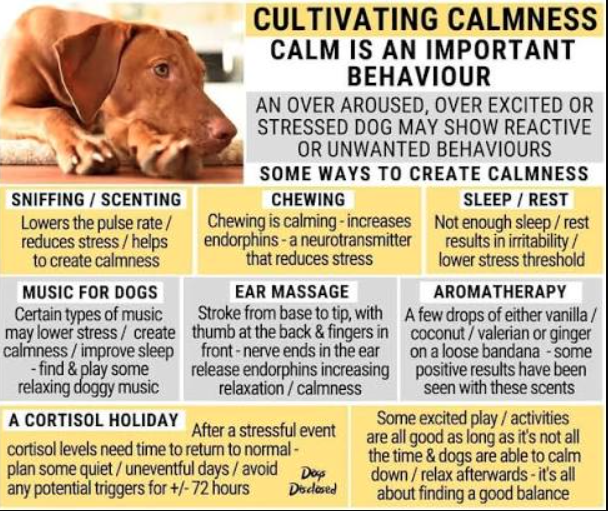
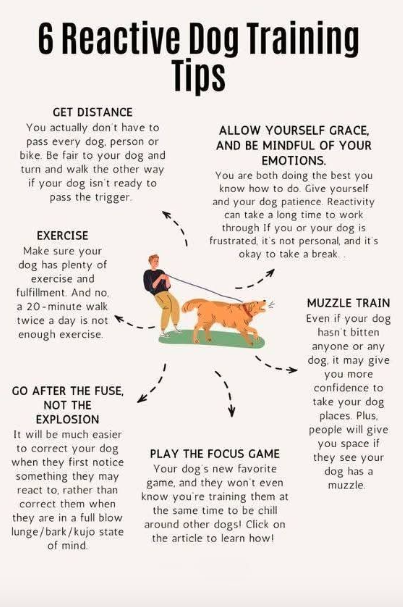
try retraining the dog (and yourself!) from scratch as if they have just arrived, alongside strict and consistent decompression rules. Methods like new positive behaviour intervention (see our blog on this) by rebooting leaving/ household/ walk routines to avoid situation and separation anxiety, reasonable but non-habitual reward system for reinforcement if you’re using treats to rewire your dog’s responses, and (re)establishment of positive behaviour, distract, redirect to reward, or environmental enrichment (toys, activities, treats, sniffing and digging areas)
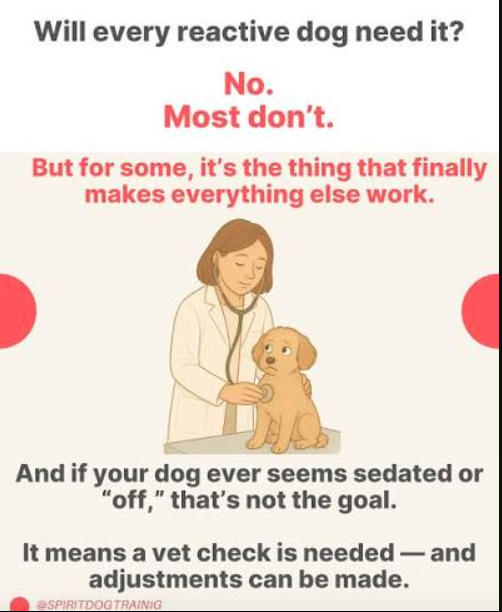
medicate (with veterinary advice and honest, informed canine appraisal given by an informed
carer) pharmaceutically (SSRIs like fluoxetine), herbally e.g. valerian (Lloyd, Willis and Taylor, 2019) or homeopathically (Reimer, 2020). Pharmaceuticals are usually a last resort after trying the above ways to re-ground your dog and giving them a chance to de-stress and process these changes. But using herbal calmers which are more gentle with few side effects can help your dog at the start of ‘re-learning’ them, as they help dogs sleep and relax enough to start showing you their ‘happy’ body language. This can help you feel you are making progress with your dog, so your body language changes for the better, which your dog will pick up on right away and help them become happier in themselves. Some herbs are suitable for humans as well, and we sell many herbal mixes in our rescue shop.
So why is your dog reactive? Most likely because they’re scared and stressed, and feel like you don’t have their back when they get big feelings. But always consult a good behaviourist and get a vet check to rule out possible pain or disease issues, or neurological problems due to (bad) breeding or trauma from life experiences they had before you adopted them. It’s time to step up and help them be the best dog they can be.
*******************************************************
This blog is an adaptation of two of our academic essays that were peer reviewed in 2022. For a full reading list of the academic works mentioned in the blog, please contact the rescue. In the meantime, here are some useful general links to help you help your dog, and yourself.
*******************************************************
GENERAL FURTHER READING.
A. L. Roshier, A.L., E. A. McBride, E.A., (2013) ‘Canine behaviour problems: discussions between veterinarians and dog owners during annual booster consultations’. Veterinary Record British Veterinary Association.https://doi.org/10.1136/vr.101125
Understanding reactivity (in depth) https://www.dogstrust.org.uk/dog-advice/training/unwanted-behaviours/reactive-dog
Understanding body language https://www.dogstrust.ie/dog-advice/training/understanding-your-dog/body-language
Body language case study https://eileenanddogs.com/blog/2013/02/14/dog-facial-expressions-stress/
How to tell if your dog is happy https://happytailpuppies.com/blogs/news/the-ultimate-joy-checklist-signs-of-a-happy-dog?srsltid=AfmBOorHJzm3n16FnY7vAcCPxU7Q6Z3IC_weUW-7EMFqZArQ7jww5y-B
Creating safe spaces https://houndy.dogfuriendly.com/dog-zones-how-to-create-the-ideal-hideaway-for-your-pet/
Medication for dogs https://www.drjensdogblog.com/behavior-medication-first-line-therapy-or-last-resort/
Reactivity on lead https://www.noblewoof.com/positive-dog-training-blog/reactive-dog-handbook